


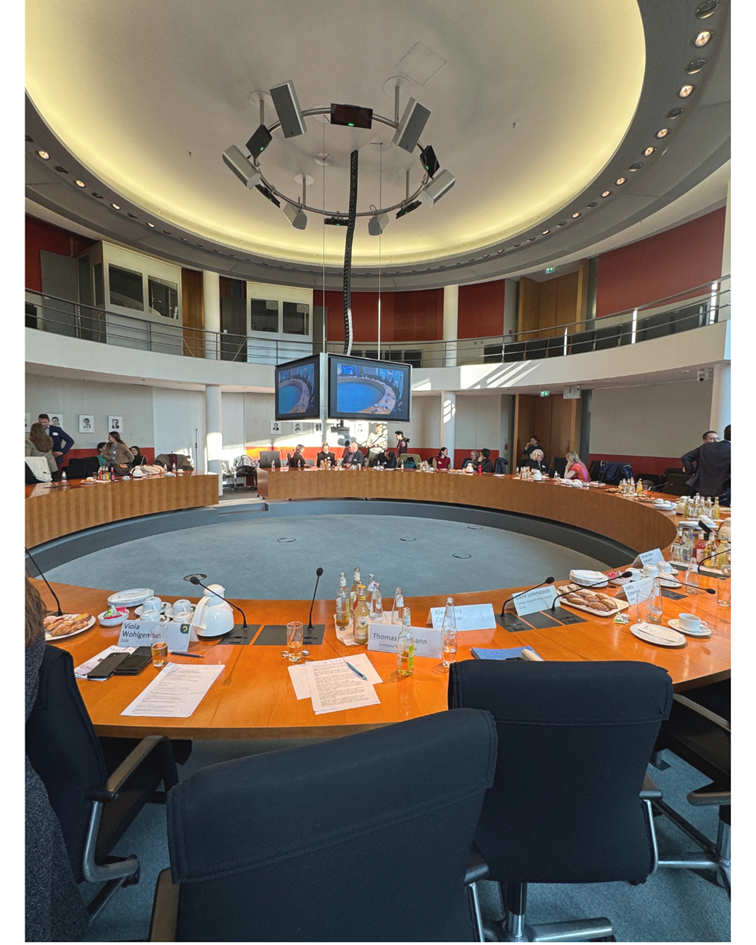
On 20 January, members of the FAIR FASHION team attended a parliamentary expert discussion in Berlin on the introduction of Extended Producer Responsibility (EPR) for textiles in Germany.[al1]
As the fashion industry continues to struggle with overproduction and textile waste, regulatory frameworks such as EPR are becoming central to shaping its future. Around 100 billion garments are produced globally each year, with 92 million tonnes ending up in landfills. Less than 1% of textile materials are recycled into new garments.
In 2023, the European Commission proposed a revision of the EU Waste Framework Directive, introducing mandatory and harmonised Extended Producer Responsibility (EPR) schemes for textiles across all EU Member States. By 2025/2026, Member States must implement national EPR systems, requiring companies placing textiles on the market to contribute financially to collection, sorting, re-use and recycling systems.
The FAIR FASHION Erasmus+ Project actively engages with the structural transformation of the textile sector. Through its pan-European consortium, the project develops new curricula at the intersection of sustainability, digital innovation and inclusive entrepreneurship. This work focuses on addressing the environmental and social impact of textiles, particularly in light of rising waste volumes and increasing regulatory pressure.
EPR in practice - Parliamentary debate in Germany
The importance of how EPR is implemented at national level became clear on 20 January. The discussion was initiated by Julia Schneider, Member of Parliament for Alliance 90/The Greens, a German political party with a strong focus on environmental protection and sustainability, who invited a range of stakeholders to share perspectives on the national implementation of EPR for textiles in Germany.
What does EPR actually require from companies?
Extended Producer Responsibility (EPR) means that companies take financial and organisational responsibility for the entire lifecycle of their products, including the post-consumer phase, once textiles become waste. By shifting responsibility from municipalities and taxpayers to producers, EPR creates a structural incentive to rethink product design, volumes and business models, making it a central lever for circularity in the textile sector.[al2]
In practice, EPR fees are intended to finance:
Circular Business in Practice: Insights from the FAIR FASHION Case Studies
Importantly, several companies featured in FAIR FASHION’s case study collection already demonstrate how these principles can be translated into concrete business practices.
For example, Son of a Tailor in Denmark operates on a made-to-order production model supported by algorithmic sizing, eliminating overproduction and significantly reducing waste. Kokolor has developed a zero-waste production cycle that combines just-in-time manufacturing, upcycling of production leftovers and the recycling of old garments into new yarn. Similarly, Saendorn GmbH reduces material waste by limiting sampling rounds and integrating leftover stock into new collections while prioritising durability through carefully selected blended materials.
Repair and re-use models are also gaining strategic importance. The Dutch platform MENDED digitises garment repair and integrates it into brand strategies, transforming repair from a niche service into a scalable and brand-enhancing offering. Soulland complements this approach by integrating repair services and resale initiatives into its circular design strategy while also working with digital product identification systems to enhance traceability.
In the field of material innovation, OCTO Germany develops water-repellent yarns without harmful fluoropolymers, demonstrating how product performance and environmental responsibility can be aligned. Meanwhile, companies such as Myth AI and The Fabricant leverage AI-driven 3D design tools to reduce physical sampling, thereby lowering material waste at the development stage.
Taken together, these examples illustrate that EPR does not introduce entirely new responsibilities but accelerates and formalises practices that forward-looking companies have already begun to implement.
For initiatives such as FAIR FASHION, this underlines the importance of equipping future fashion professionals not only with design expertise, but also with policy literacy, digital competencies and a solid understanding of circular business models. The transition to a circular textile economy will not be achieved through regulation alone, but through the people capable of translating policy into practice.
By Ramona Möllers
Edited by Alexandro Dreyer Duarte
Hochschule Niederrhein
Sources:
Earth.Org. (n.d.). Statistics about fast fashion waste.
https://earth.org/statistics-about-fast-fashion-waste/
European Commission. (2023). Extended Producer Responsibility for textiles (Factsheet). European Union.
https://ec.europa.eu/commission/presscorner/api/files/attachment/875561/Factsheet%20-%20Extended%20Producer%20Responsibility%20for%20textiles.pdf
European Commission. (n.d.). Waste Framework Directive. European Union.
https://environment.ec.europa.eu/topics/waste-and-recycling/waste-framework-directive_en
[al1]I would begin the blog with this, as it is the most interesting hook to the blog. Somehting like "New insights into the EPR regulations for EU as heard on 20th January in Berlin by FAIR FASHION" - This could also be a better title for the blog article.
[al2]Maybe you could mention some case studies that we have completed who already consider the entire customer loop and mention how other companies could learn from smaller sustainable businesses on more circular methods